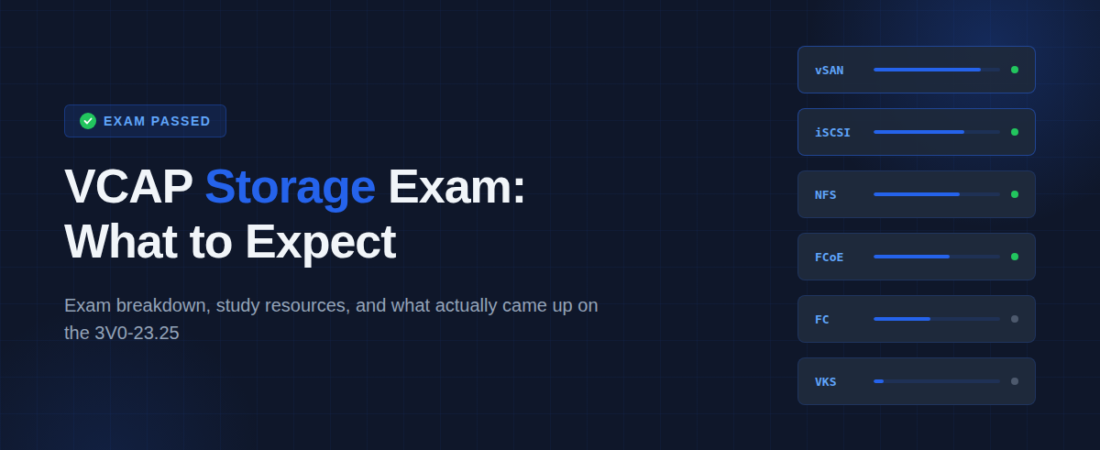
I sat the VMware Certified Advanced Professional – VMware Cloud Foundation Storage (VCAP-VCF Storage) exam (3V0-23.25) today and passed. If you’re planning to take it, here’s a breakdown of what I ran into and where I’d focus your study time.
Exam Overview
| Exam Name | Advanced VMware Cloud Foundation 9.0 Storage |
| Exam Code | 3V0-23.25 |
| Duration | 135 Minutes |
| Number of Questions | 60 |
| Passing Score | 300 out of 500 (Scaled) |
| Question Formats | Multiple Choice, Multiple Selection, Drag and Drop, Matching, and Sequencing |
What Actually Came Up
The exam was heavily weighted toward storage architecture and protocol knowledge. I’m talking about the real nuts and bolts of how storage works in a vSphere environment, not surface-level definitions.
The bulk of the questions covered:
- iSCSI configuration, initiator types, multipathing, and CHAP authentication
- Fibre Channel over Ethernet (FCoE) architecture, converged network adapters, and how FCoE fits into a data centre network design
- NFS datastore connectivity, NFS 3 vs NFS 4.1 differences, Kerberos authentication, and storage policy behaviour
- vSAN architecture models (OSA vs ESA), fault domains, storage policies, and capacity planning
- Storage architecture models covering active-active vs active-passive array configurations, ALUA path management, and how different array models affect your design decisions
- Stretched clusters and the requirements around witness appliance placement, site affinity rules, and how storage behaves during a site partition
- Fibre Channel zoning practices, including single-initiator/single-target vs single-initiator/multiple-target zone configurations, and how zoning ties into your overall SAN fabric design
There was a good amount of crossover between these topics too. You’d get a scenario that started as a stretched cluster question but was really testing whether you understood how the underlying storage replication and zoning worked across sites.
If you’ve spent time hands-on with these protocols and architectures, you’ll recognise the scenarios immediately. If you’ve only read the docs without actually configuring them, you’ll struggle. I’ve been running NFS 4.1 in my homelab for a while now (my TrueNAS box serves an NFS share to my HPE management host via vCenter), and that direct experience made a noticeable difference on those questions. For the FC zoning and stretched cluster content, I leaned on what I’ve seen in client environments. You can’t easily lab a full SAN fabric at home, so if you don’t have production exposure, spend extra time with VMware’s Hands-On Labs for those areas.
VKS: Barely There
I got one question related to VMware Kubernetes Services. One. Given how much noise VKS gets in the certification study guides, I was surprised it was so light. That said, don’t skip it entirely. Know the basics of how persistent volumes and storage classes work in a Kubernetes context on vSphere, but don’t burn weeks on it. One architectural nuance to watch for on this front: VKS exposes standard Kubernetes APIs, but under the hood everything maps onto vSphere Supervisor Namespaces. Storage allocations go through SPBM, so the exam may test whether you understand that a PersistentVolumeClaim in VKS ultimately resolves to a VM storage policy, not a traditional Kubernetes CSI flow.
Where I’d Focus
If I were advising someone preparing for this exam, here’s where I’d spend the majority of my time.
First, get comfortable with storage architecture decisions. The exam tests whether you can design a storage solution given a set of constraints, not just identify what a protocol does. You need to understand when to recommend iSCSI over FCoE, why you’d choose NFS 4.1 over NFS 3, and what vSAN topology fits a given failure domain requirement.
Second, know your multipathing. PSP configurations (Round Robin, Fixed, MRU), SATP rules, and how path failover actually works came up repeatedly. In my consulting work, I’ve seen environments where a misconfigured PSP caused significant performance issues, and the exam tests exactly that kind of scenario-based reasoning.
Third, understand storage policies end to end. This means vSAN storage policies, VM storage policies, SPBM (Storage Policy-Based Management), and how they interact with different backing datastores. The questions weren’t asking you to recite policy settings. They were giving you a design requirement and asking which policy configuration satisfies it. One architectural trap to watch for: vSAN ESA virtual disks are log-structured and always thin-provisioned. Object Space Reservation (OSR) in ESA only reserves logical capacity for future expansion, it doesn’t pre-allocate physical blocks the way OSA does. I’ve seen this catch people out in design scenarios where they assume OSR behaves the same across both architectures.
Fourth, don’t underestimate stretched clusters and FC zoning. Stretched cluster questions test whether you understand witness placement, what happens during a network partition, and how site affinity policies interact with vSAN fault domains. For zoning, know why single-initiator/single-target is the recommended practice, what happens when you deviate from it, and how ALUA interacts with your zone configuration on active-passive arrays. I’ve worked on a few client environments where the zoning was a mess of multi-initiator zones, and debugging the path thrashing that caused taught me more than any study guide.
My Approach to Studying
I used a combination of VMware documentation, Hands-On Labs, and my own homelab. The homelab was probably the single most useful resource. When you’ve actually broken something and fixed it at 11pm on a Wednesday, you remember how it works.
I also found that working through real client scenarios helped. When I’m deploying storage for a VCF environment, I’m making the same design decisions the exam asks about. If you have access to production or lab environments where you can experiment with different storage backends, use them.
Study Resources
Here are the resources I’d point you toward if you’re preparing:
- Official 3V0-23.25 Exam Guide (Broadcom) – Start here. The exam blueprint lists every objective and tells you exactly what’s in scope. I went through each objective and made sure I could explain it to someone else before I considered it “done.”
- VMware Hands-On Labs – Free, browser-based labs. The vSAN labs are particularly good for getting hands-on with storage policies, stretched clusters, and ESA. If you don’t have a homelab, these are your next best option.
- VCF 9.0 Core Storage Guides (Broadcom) – The old vSAN Specialist certification (5V0-22.23) was retired by Broadcom in December 2025, so don’t rely on that prep guide. The VCF 9.0 storage documentation and exam objectives for the 3V0-23.25 are your best source for vSAN-specific topics like data placement, policy compliance, and maintenance mode behaviour.
- VMware Certification Paths (Broadcom) – Useful for understanding where VCAP Storage sits in the broader certification structure and what prerequisites apply.
- Broadcom Certification Portal – For booking the exam through Pearson VUE and checking your credential status.
One thing I’d add: don’t waste time on brain dump sites. The scenario-based questions on this exam require you to actually think through a design problem. Memorising answers from a question bank won’t help when the exam gives you a unique set of constraints and asks you to pick the right storage architecture.
Exam Day Time Management
With 60 questions in 135 minutes, you get roughly 2 minutes and 15 seconds per question. That sounds manageable until you hit a drag-and-drop scenario with a full page of constraints to read through.
My approach was to read the actual question first, before the scenario text. Most questions end with a clear ask: “Which PSP should be configured?” or “Which two storage policies satisfy this requirement?” Once you know what you’re solving for, you can scan the scenario text for the relevant details and ignore the noise. I probably saved 15 to 20 minutes across the whole exam just by reading backwards like this.
Flag anything you’re not sure about and move on. I flagged about eight questions on my first pass and came back to them at the end with fresh eyes. Two of them I’d have got wrong if I’d rushed an answer the first time round.
Broadcom Certification Policy Changes
Before you schedule your exam, be aware that Broadcom has reworked the certification lifecycle. The old VMware credentials could sit on your CV indefinitely. That’s no longer the case. VCF certifications now expire after 36 months. If you don’t renew within that window, your credential lapses.
The good news is that renewal is straightforward. Passing the VCAP exam updates your status directly, no mandatory training courses or prerequisite credits required. Just sit the exam again within the three-year window. I found this out when I was checking my own certification status before booking.
One thing to watch: older pre-Broadcom certification tracks don’t carry over into the new VCF 9.0 system. Everyone tests fresh under the current programme, regardless of what you held before. If you had a legacy VCP or VCAP from the VMware era, it won’t automatically map to the new VCF credentials.
Final Thoughts
The VCAP-VCF Storage exam is an architecture exam. It rewards people who’ve designed and troubleshot storage environments, not people who’ve memorised feature lists. If you’re a vExpert or working in VMware infrastructure day to day, you probably have more of this knowledge than you think. Just make sure you can apply it to unfamiliar scenarios under time pressure.
Good luck if you’re taking it.
For practice scenarios and a full VCF 9.0 storage study reference, check out Part 2: VCAP-VCF Storage Practice Scenarios and Study Reference.